Table tennis cases have a very important task, they protect your bat. Protection is necessary due to various reasons. There are different possibilities to protect your racket in an effective way. One popular way of doing so is it to use a table tennis case. Depending on the requirements, these are available in various designs, providing optimal protection for your bat, and your equipment.
In this article we want to introduce to you table tennis cases and their variations.
On your way to the training hall, a case provides protection against wetness, or dirt stemming from the air or stemming from your backpack/bag. Also, the rubbers of your racket are protected against sunrays. The visco-elastic rubbers can change their properties under sunlight (UV radiation). When there is a long-term (or repetitive) sunlight exposure, the rubbers lose their positive properties, such as stickiness. Of course, a case also provides protection from mechanical influences: In case your bat is dropped, the case substitutes an important protection. But also when your bat is in the bag, the bat case prevents direct contact, and friction, with other (hard) items.
Classical table tennis cases are available in the following designs:
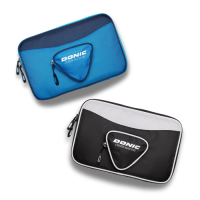
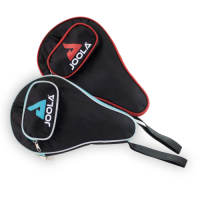
Single or double cases. These can be round shaped which is attuned to the bat. However, there are many manufacturers providing rectangular single or double bat cases. Often, these are additionally protected by a foam padding. Single bat cases are designed for one, double bat cases for two table tennis bats. In this case, the bats are stored separately (by means of a zipper). Such cases are often made of polyester or nylon.
Another type are so called table tennis suitcases. From the outside, these look like a normal suitcase (often equipped with snap locks). The outer shell is usually made of (artificial) leather or some kind of plastic, and reinforced by means of stiff plates. This results in a very good protection for your racket(s). To prevent throwing your bats to and fro within the table tennis suitcase, there is often a large foam padding. This fixates the bats when closing the suitcase without doing any harm to e.g. the rubbers. Manufacturers also offer such suitcases made of aluminum. These are extremely durable, robust, and stable. Aluminum also provides a nice and noble appearance. Both, table tennis suitcases and cases, usually also offer room for 3 additional TT balls. These are particularly well protected in table tennis suitcases, because the foam used has ball-specific, and perfectly fitting cavities.
Conclusion:
A table tennis case and a table tennis suitcase are very reasonable components which provide many advantages in a simple manner. Hence, both are definitely worth a recommendation!